

By Massimo Mastrangelo
It is no accident that the metaverse as a practical project emerged from the experience of the Covid-19 pandemic.
The concept is older, and we can say that it traces its origins back to the great science fiction classics, but the last two years have transformed it into a full-fledged business proposition, capable of dictating a name change for Facebook (now Meta) and moving billions of dollars into the capital markets.
The great migration to digital during the pandemic demonstrated the enormous advantages of being able to work and live within a secondary artificial universe.
In such a universe, the laws of space and time no longer apply, or at least can be bent largely to one's needs, enhancing human capabilities in ways yet to be explored.
The end of long commutes and the achievement of measurable productivity gains; the ability to attend meetings and conferences on different continents and on the same day; and, as if that were not enough, children able to attend school even in the midst of the worst health emergency in the last century.
Unfortunately, during the peak of the pandemic the limitations of the digital experience were no less evident.
When human interaction takes place through a screen, not a few important nuances of communication are lost.
The results of distance education have so far proved controversial, to put it mildly.
A digital work environment soon proved to be considerably more exhausting than its counterpart in the real dimension.
Humans are made for a type of immersive interaction, which takes place in the physical world, where all five senses are involved.
Some of our mental abilities, including memory, suffer greatly when we are reduced to disembodied egos on Zoom.
As far as entertainment is concerned, digital experiences are still so far from the real fun of going to a restaurant or a music concert that very few have tried, on the Internet, during the lockdown.
The immediate appeal of the metaverse is that it promises to offer the benefits of digital life while mitigating many of its shortcomings.
Instead of business meetings on Zoom, simply imagine walking into a digital room and talking with colleagues around a table, or even walking together through a virtual garden, lush with beautiful plants, and whose scent you can even smell.
I envision the metaverse as a virtual world with some of the characteristics of a city.
There will be virtual shopping malls, where users will be able to move from store to store and purchase products that will later be delivered to their physical homes; a significant improvement in the user experience in online shopping, compared to just the web page.
There will be virtual beaches where we can meet our friends to chat and play games, just like what Fortnite already offers, only in a much more realistic and fulfilling mode.
There will be no shortage of concerts and art galleries.
Will there be a valid reason to physically travel to Venice in order to visit the Biennale, instead of jumping into the metaverse and enjoying all the art and video installations making use of fully immersive technologies?
We will also be able to travel to exotic places while sitting in our living room.
It is easy to imagine the growth of a new digital economy, in which creators will be less dependent on middlemen of all kinds, as is already the case today for digital artists in NFT marketplaces (read, if you like, also my article here t.ly/hX25).
Barriers to entry are likely to be lower, and the audience potentially much larger than in the real world.
The metaverse will have to be highly simultaneous, it will have to be continuously updated by the inputs of its millions, or potentially billions, of users.
The only way a virtual experience can compete with the real one is if it acquires the same flow and complexity.
It is not enough to encounter a prepackaged version of reality. One may wish to travel in a virtual Biennial; ideally, even, deciding to intervene at the time of the event's greatest attendance, in order to interact with many other people.
It should be possible to acquire some of the artworks, both in physical and virtual formats.
Virtual objects, once acquired, will be stored within the metaverse.
One should be able to bring them into other digital spaces, without sacrificing their virtual authenticity, in a world where "virtual authenticity" is not a contradiction in terms, but is a tangible virtual reality, and certified by a non-fungible smart contract.
Going back to the virtual malls mentioned above for a moment, let's imagine users visiting a virtual car dealership where they can purchase a physical model to be delivered to their physical homes.
They will want to test the car virtually, and may even be interested in purchasing a virtual version of the same car to drive in the metaverse.
The virtual and physical worlds will become increasingly integrated and interactive.
An immersive three-dimensional environment expresses the vision of a metaverse more fully and naturally than other interfaces, but it is not the most important feature of the innovation.
What truly distinguishes the metaverse is its autonomy from the physical world.
The metaverse exists on its own. It has a life of its own. It creates a genuinely alternative world.
The metaverse cannot be compared to the Internet because it aims to place us within the digital experience, translating it into an embodied Internet on a more or less infinite basis.
One accesses the Internet. You enter the metaverse.
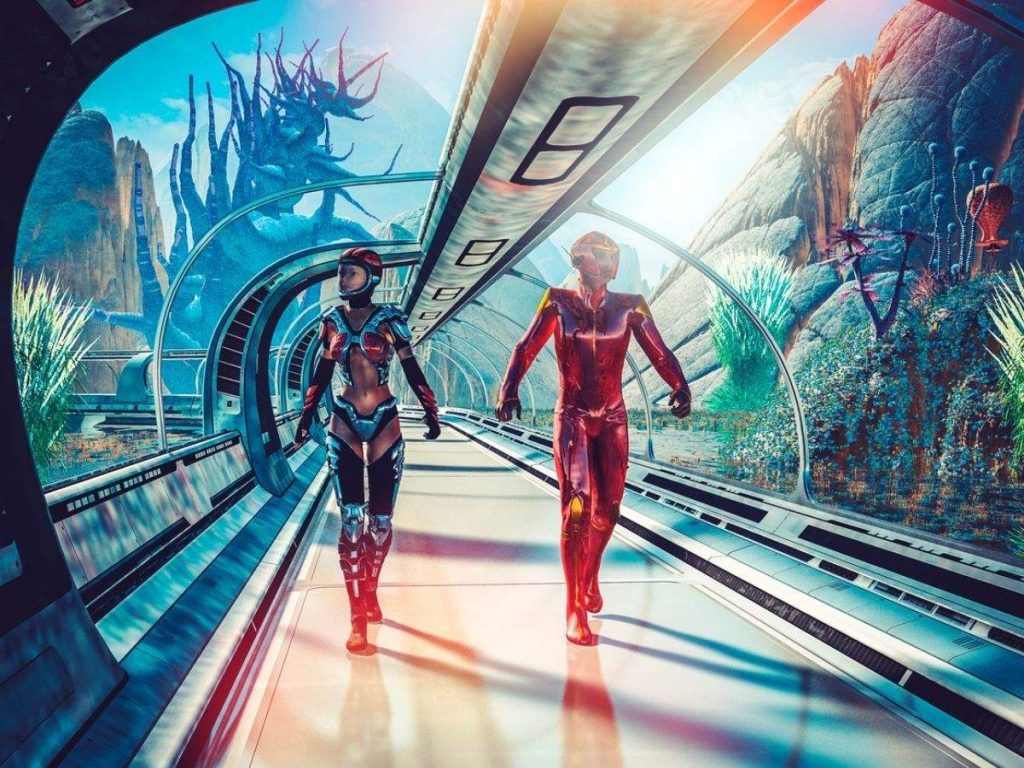
The relationship between the user and the digital environment is turned upside down.
With the Internet, the user remains sovereign, dictating when and how digital interactions take place.
In the metaverse, the user finds himself or herself completely surrounded by the platform, and the quality of experiences often depends on whether he or she accepts this incontrovertible fact.
When we are operating with our pc, if we are flying an airplane with our flight simulator, when we get bored with the game we can simply click on closing the "flight simulation" application, and get down to doing something else.
In the metaverse, when I leave my house and have to cross the street, it will not be possible for me to authoritatively stop passing cars, because inside those cars will be other free users like me, over whom I will have no legitimate authority; as in the physical world.
No longer will I command the software through my keyboard, but I will enter the software and be subject to the rules of the metaverse.
I will be able to do almost anything I dreamed of doing in the physical world, that yes, but my freedom will end where other users' freedom begins.
Nothing will prevent us from using non-virtual technologies to enter the metaverse, at least in part.
There are obvious practical limitations to implementing virtual reality headsets, for example.
If our metaverse avatar will be programmed to attend a music concert but at that time we will be in the subway, in the physical world, it should be possible to listen to the concert through an app with our smartphone, using normal headphones.
In a context in which two worlds , the physical and the digital, will be coexisting and interactive, the smartphone, which today is our privileged gateway to digital services, will remain in the round part of the physical world and its tools, for which it will be necessary to find increasingly efficient communication protocols with the metaverse.
But the metaverse will be completely persistent and continuous.
If the ambition of the metaverse is to constitute an artificial world, capable over time of rivaling the real one, experiences in the virtual dimension will have to acquire meaning in reference to other experiences coexisting in the metaverse, and not just those that will take place in the real world.
And this will mean that the metaverse will never disappear, really, even when a user momentarily withdraws into real life.
The metaverse will either persist or persist.
In other words, in its full deployment, it will never be possible to "turn off" the metaverse in our lives, as we do today with a playstation when we are past the urge to play.
Does this sound like a disturbing prospect?
Don't worry, you have already put your little feet in the ocean of the fourth dimension.
Some aspects of the metaverse have existed for a while.
How to interpret the advent of social media, if not as the first stage of the metaverse?
Take Twitter as an example.
It has some of the characteristics of an artificial world, starting with its high pervasiveness and continuity in the lives of hundreds of millions of individuals, an aspect that alone demonstrates its extraordinary success.
Technically, Twitter is rather primitive; a predominantly verbal medium to which low bandwidth is required.
Conceptually, however, it is a real revolution: a new world in which users interact, rather than contemplate, and which continues to exist and develop even in their absence.
You go out, go to sleep, and when you wake up, developments, responses, and interactions about your messaging activity have been generated.
It is a broadcasting tool; the fundamental difference with Facebook is that in Twitter I am not limited to interacting with my friends, but, through a hashtag I can potentially have the president of the United States read (and therefore potentially communicate with them directly), as well as the Pope or Jennifer Lopez.
How many individuals, very often sadly clueless even if famous, have had their lives and careers literally jeopardized as a result of an ill-considered tweet, abetted by the aforementioned universality that Twitter bestows on its users' messages?
A beast, that of general disapproval, which bit them right away, but also kept growing and moving, even at the time when those who had published the incriminating nonsense wanted to hide and be forgotten for a while.
What makes Twitter compelling is its actual resemblance to the physical world in the power of its autonomous operations, as well as its ability, far greater than that of Facebook, Instagram, Reddit, Linkedin, Pinterest and the other massive socials, to produce concrete and immediate effects in people's real lives.
Imagine that in your metaverse spaces, someday, the pictures in the rooms could be replaced by little Twitter windows where anyone who wants to message you would be able to get in touch, and potentially talk to you.
Imagine that, after granting contact to one of these talking squares on your walls, you could allow the interlocutor to jump, from the square, directly to one of the chairs in your virtual home or office, for a chat or job interview.
Many developments of current features and interactions on social are early manifestations of many things that the metaverse is likely to bring us.
What is happening in the present day with Twitter is a clear representation, in embryo, of the role that the metaverse will acquire in political, social and economic life at the time of its deployment.
Remember when the Internet came into our lives, seemingly out of nowhere?
Of course, it did not really come "out of nowhere," as the preparatory stages of the arrival of the Internet in our existences (availability of a PC, and even earlier the very first networks for military and scientific use, such as Arpanet) had, in fact, been completed by the deployment of home and business connectivity, thanks to the large architecture of nodes that had been formed over decades.
In the 1990s we used to think it would be forever, and it has been.
It now seems clear that we are on the cusp of the successor to the Web: the metaverse.
Much has been written about the ongoing clash of titans between Meta and Microsoft to gain the position of incumbent in the new virtual world, to which humanity as a whole is on the verge of migrating.
Let us not forget, however, that behind these two giants are actors who, in the shadows, are giving the race to the new social dimension a very high geo-economic-political significance.
One of China's leading think-tanks recently published a report on the implications of the metaverse for national security, perhaps the first such reflection.
The main conclusion was not, as many might assume, that we will soon be fighting wars in the metaverse, but something much more plausible and relevant.
The report sees three immediate impacts of the metaverse.
First, it will be a driver for technological innovation and, in some cases, in areas adjacent to military interests: simulation graphics, artificial intelligence, wearable devices, robotic technology, and brain-computer interface.
The second will be to move the digital ecosystem and the digital economy to new technology platforms: e-commerce will largely migrate into the metaverse, from current platforms, precisely because of the ability to offer potential customers more interactions with the product offered.
In short, the integration of the physical world with virtual reality will realize perhaps the oldest ambition of the Internet.
The report anticipates that the metaverse could have profound consequences for the global distribution of power.
It will trigger a new round of reshuffling in the global technological order.
Some companies and countries will have de facto setbacks; others may have opportunities for advancement that had been denied them in the physical world.
This has already happened with the Internet economy, when Europe could not help but fall behind the United States, and China was able to resist the empire of the big American platforms with a decidedly assertive attitude.
Also according to the Chinese think tank, U.S. authorities may hope to use the metaverse revolution to propel U.S. companies to a new and unassailable position of global dominance, while leveraging the new technology to promote American culture and American values.
In this light, the aggressiveness with which Meta immediately took the initiative is seen as particularly disturbing.
It is easy to see why many might consider the concept of the metaverse to be overly influenced by Western ideas.
The metaverse is, first and foremost, a method of evasion.
Each individual gains the freedom to pursue their most personal fantasies, in the metaverse.
It is as if the common world fragments into millions or billions of private universes.
The more conservative part of the Eastern intelligentsia argues that the metaverse is like a drug, so powerful that it breaks our connection with the world around us, and that humanity is now at a crossroads: in one direction lies the exploration of space; the other leads toward inwardness, virtual reality, toward the inner, private dimension of entertainment.
The frontier of freedom that pontentially can be achieved through the metaverse becomes clearly visible here, as does the potential to become an instrument through which an individual is free to choose the reality he or she prefers, free from political and state, census or economic constraints.
It is the advanced frontier of the contest between human freedom and the constraints of reality,
and potentially a sociological ground in which to redefine, according to the current condition of the world, the very concept of reality.
#metaverse #microsoft #meta




 English
  Italiano
  Español de México